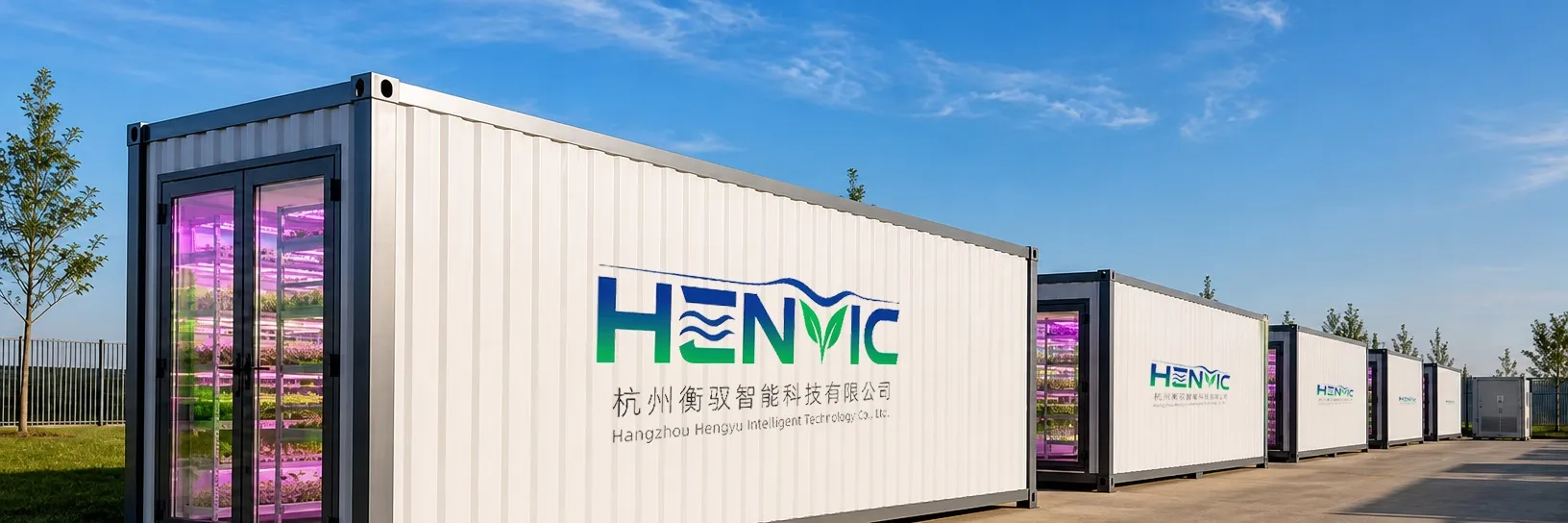
Most container farm business plans are written in the wrong order. They start with the equipment — a container, a tier count, a lighting specification — and then work backwards to find a market that will pay for what the box produces. The five questions below reverse that sequence. If you can't answer them concretely, the rest of the plan doesn't matter yet, because the answers determine whether there's a business at all.
Question one: Who is going to buy this, by name, and at what price?
Not "restaurants" and not "health-conscious consumers." Names. A specific chef who has told you what they pay now, a specific retailer who has agreed to a shelf slot, a specific distributor with a signed intent. And a price that is set by your customer's alternative, not by your cost.
This is the question that kills most projects, and it kills them silently. A new grower builds a capacity model, projects a harvest, and assumes the harvest sells at a premium because it's local, clean, and consistent. Then it meets the actual market: a wholesale buyer who prices lettuce against product trucked in from three states away, and who sees no reason to pay double for a head that looks the same.
The premium has to be justified by something the buyer genuinely cannot get elsewhere. Consistency through a polar winter. A variety that doesn't survive shipping. Delivery within four hours of harvest. A food-safety story a procurement department actually needs. If you can't name the specific buyer and the specific reason they'll pay above commodity price, you're not looking at a business — you're looking at a very expensive hobby with a harvest schedule.
Question two: What is your actual, contracted electricity rate?
Not the national average. Not the number on a vendor's slide. The rate on the specific site you're considering, at the specific supply capacity you need, under the specific tariff structure you'll be billed on.
A container farm's largest recurring cost is power, and the spread between markets is wide enough to decide the outcome on its own. A rate that makes a farm viable in one jurisdiction can make the identical operation unprofitable two hundred kilometres away. Worse, the tariff structure matters as much as the headline number: demand charges, time-of-use pricing, and the cost of upgrading to a three-phase supply can all be material, and none of them appear in a generic energy-cost estimate.
Do the arithmetic before you sign a lease, not after. Take your projected annual kilowatt-hours — lighting, cooling, dehumidification, circulation, controls, plus the losses you'll underestimate — and multiply them by your real rate. If that figure doesn't leave room for equipment, labour, and a margin, the site is wrong, the crop is wrong, or the project is wrong.
Question three: Which crop — and does its value per square metre per cycle clear your cost per square metre per cycle?
This is the only calculation that determines whether the system can work, and it's a ratio rather than a single number. On the revenue side, take the crop's price per kilogram, multiply by the marketable yield per square metre, and divide by the cycle length to get a monthly value density. On the cost side, take your electricity, labour, consumables, and amortised capital per square metre of growing area.
The crops that clear the bar are fast, small, valuable, and uniform: leafy greens, herbs, microgreens, and specialty varieties where scarcity or freshness commands a real price. Herbs and living plants often outperform lettuce specifically because they're sold as a living product with a much longer shelf life. The crops that don't clear it are slow, bulky, and priced against field supply — anything with a 90-day cycle, anything with a low marketable fraction of total biomass, anything the customer can buy cheaply from a truck.
The mistake to avoid is choosing the crop before the customer. The crop is a consequence of the market you've secured, not an input you decide on first.
Question four: Who keeps it running — and what happens the first time something breaks?
A container farm is not a set-and-forget appliance. It's an industrial facility running continuously, with refrigeration, HVAC, pumps, sensors, and a control system that all need maintenance by someone who knows what they're doing. The labour is not purely agricultural and it isn't purely mechanical; it's a hybrid skill set that's genuinely hard to hire.
Look honestly at the staffing model. Can one person run it? What happens during their holiday, or when they're sick? Is there a maintenance retainer with a refrigeration contractor, or does a failed chiller mean a crop and a two-week interruption while you find someone? Do you hold spare parts, and if the site is remote, does that change the answer?
The failure mode here is slow and cumulative. Deferred maintenance doesn't stop the farm; it lowers its output while fixed costs stay flat. A farm that planned ten crop turns a year and delivers seven has permanently lost thirty per cent of its revenue without any single obvious failure to point at. Budget maintenance as a fixed cost from day one, not as an emergency.
Question five: What is your exit condition?
This is the question entrepreneurs find least comfortable, and it's the one that determines whether the venture costs you a defined sum or everything you have.
Decide in advance what evidence would tell you to stop. A specific yield threshold you haven't hit by month twelve. A specific number of contracted customers by month eighteen. A specific cumulative loss beyond which you liquidate the equipment rather than fund another quarter. Write it down before you're emotionally committed, because the moment you are, you'll find a reason to extend every deadline.
The container farm failure pattern is well-worn: year one runs over budget on equipment and under on yield; year two reconciles the optimistic model against the real utility bill and the operator responds by pushing the system harder, raising energy costs and deferring maintenance; year three arrives with failed equipment and accumulated debt service at the same time, and there's no reserve left. An exit condition defined in advance is the only thing that reliably interrupts that sequence.
What the answers should look like together
The operators who make this work don't have better technology or a cleverer growing method. They have a customer who pays a real premium before the container is ordered, a power rate that makes year-round indoor growing arithmetically possible, a crop selected to serve that customer at acceptable density, a maintenance plan they're actually funding, and a stop-loss they'll honour.
None of those five answers requires optimism. All of them require evidence. The container farm isn't the project — it's the least important line item in the plan. Answer the five questions first, and if they don't come back clean, the box shouldn't be ordered.